
Most people underestimate how much the wrong certification can cost them — not just money, but actual job opportunities. The best fitness certifications are separated by accreditation status, employer acceptance, and how well their prep resources get you through the exam. Choosing among dozens of certifying bodies is confusing, and high failure rates make the wrong choice expensive. After reviewing the top options across credibility, pass rates, and cost-to-value, this guide breaks down the five worth your time in 2026.
How the picks were chosen
Public information guided every pick: user reviews, official program pages, employer acceptance data, and ratings from trusted review platforms. Only certifications with a demonstrated track record in fitness training made the cut. Options without clear accreditation signals or verifiable outcomes were left off entirely.
→ See the full research breakdown
- IPTA — Best for aspiring personal trainers seeking affordable, accredited certification
- NASM — Best for professional fitness certification and continuing education
- ACE — Best for nonprofit-backed certification across diverse fitness populations
- NSCA — Best for strength and conditioning education and research-based training
- NCCPT — Best for affordable personal trainer certification with personalized support
Why fitness certifications are worth the investment
Picking the wrong certification is one of the most common and costly mistakes in this field. Some credentials look legitimate on the surface but aren’t recognized by the gyms and hospitals that do the hiring.
NCCA accreditation is the baseline filter most serious employers use, and not every certification clears it. Many candidates also fail on the first attempt simply because they lack solid prep resources, which raises the stakes further.
A well-chosen certification doesn’t just get you hired — it sets your earning ceiling. Trainers with recognized credentials consistently see stronger starting salaries and faster advancement. That makes getting this right far more meaningful than saving a few dollars on a cheaper, less-respected program.
Comparison table
Note: Figures below are drawn from review platforms and the official websites of the listed organizations. Pricing and timelines change, so confirm current details before you enroll.
| Company | Established | Headquartered In | Typical Time to Certify | Starting Price |
| IPTA | — | Online | 4–8 weeks | $399 (Rookie) |
| NASM | 1987 | Gilbert, Arizona | 8–12 weeks | Varies |
| ACE | 1985 | San Diego, California | Self-paced (≈3 months) | Varies |
| NSCA | 1978 | Colorado Springs, CO | Self-paced; varies | Varies |
| NCCPT | 1988 | — | Self-paced | Under $720 |
IPTA — Best for aspiring personal trainers seeking affordable, accredited certification
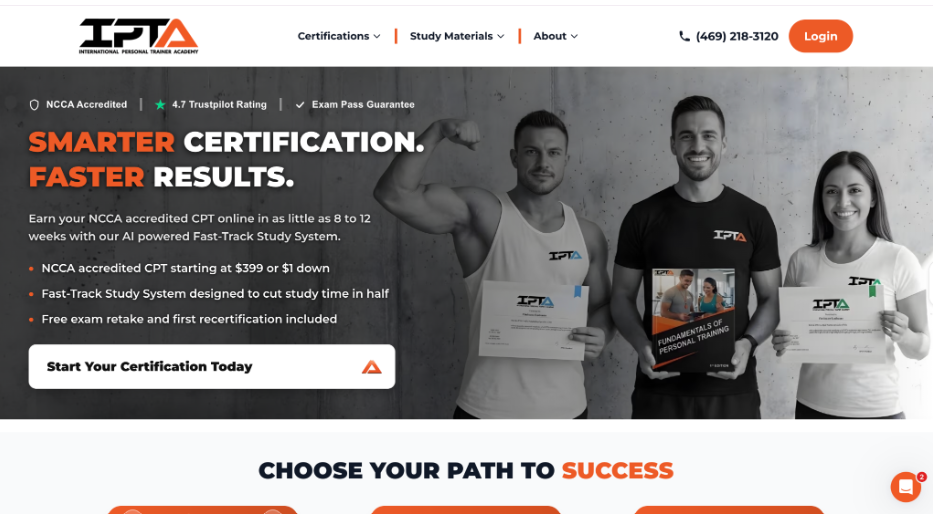
How does IPTA operate?
IPTA is a fully online provider built for people entering the personal training field. It offers NCCA-accredited certifications in personal training, nutrition coaching, and bodybuilding coaching. What sets it apart is pairing its own programs with dedicated study materials for major exams like NASM, ACE, ACSM, ISSA, NSCA, and NCSF. The Fast-Track Study System cuts prep time — roughly 4–8 weeks for a focused student — without cutting corners, and the programs come with exam pass guarantees and unlimited retakes.
Why pick IPTA?
For trainers who want accredited credentials without a premium price, IPTA’s Rookie tier at $399 keeps quality certification accessible. That price includes free CPR/AED certification and career business courses — a real bonus. The Job Assurance Guarantee for eligible U.S. students is a confidence signal that’s rare at this price point (the eligibility terms are worth a read).
The review roundup
IPTA holds a 4.7-star rating on Trustpilot, strong for a certification platform in a space where prep quality varies wildly. Students consistently mention the support structure and the clarity of the study materials as the biggest wins. Coverage in outlets like Forbes and USA Today, plus acceptance by major gym brands, adds real-world credibility.
NASM — Best for professional fitness certification and continuing education
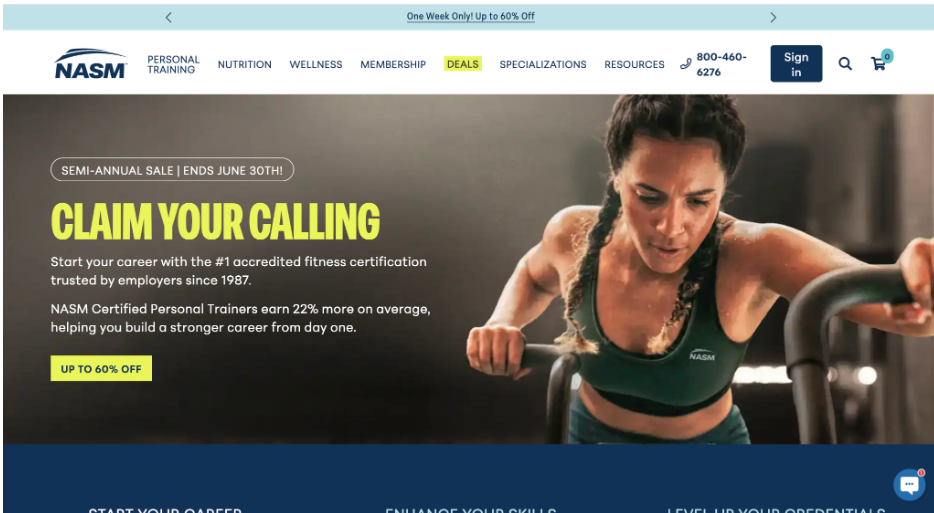
How does NASM operate?
NASM has built evidence-based fitness education since 1987, and its scale is hard to overlook. It has credentialed more than 1.4 million professionals across 100-plus countries and maintains partnerships with 14,000-plus gyms and health clubs. The curriculum is built around the Optimum Performance Training (OPT) model — scientifically grounded and NCCA-accredited. Beyond the CPT, NASM offers specializations in corrective exercise, performance improvement, nutrition coaching, and wellness coaching, making it a full career development system rather than a single exam.
Why pick NASM?
When every NBA, NFL, and MLB team trusts your credentialing system, employer acceptance stops being a question. NASM’s recognition as a top online learning provider in recent years, per Newsweek and Statista, backs the reputation with data. The self-paced CPT typically takes 8 to 12 weeks — a longer runway than IPTA’s fast-track route, but the trade is the broadest acceptance in the field.
The review roundup
NASM’s reputation in professional sports and fitness facilities does most of the talking. Feedback centers on the depth of the curriculum and how widely the credential is accepted by employers. That kind of broad recognition is hard to match at any price.
ACE — Best for nonprofit-backed certification across diverse fitness populations
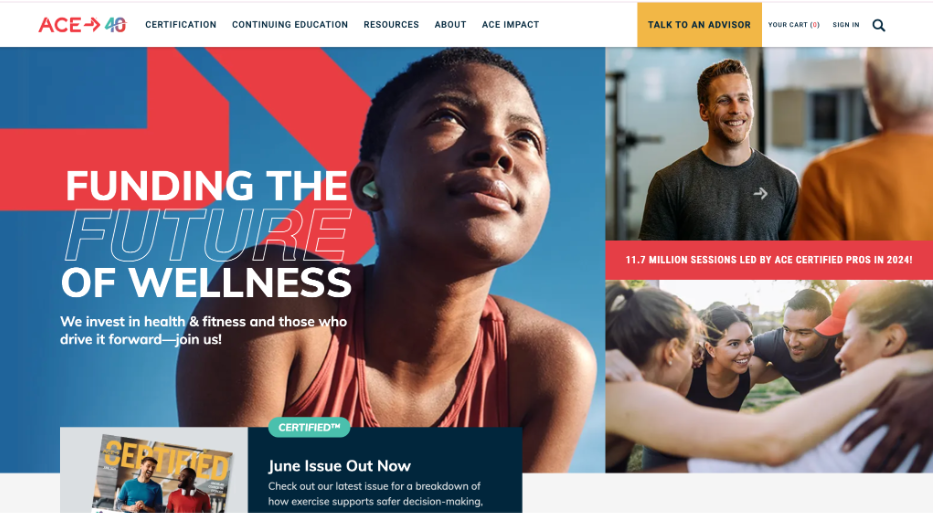
How does ACE operate?
ACE has run as a nonprofit dedicated to improving global physical activity since 1985. It offers four NCCA-accredited certifications covering personal training, group fitness instruction, health coaching, and medical exercise specialization, plus specialist programs in behavior change, weight management, senior fitness, and sports nutrition. With roughly 90,000 certified professionals active across six continents, ACE operates at a scale that gives its credential real international weight, not just U.S.-centric recognition.
Why pick ACE?
Trainers who want to work across varied populations — from senior clients to medical exercise settings — get a lot of pathway options from ACE without switching providers. Forty years of nonprofit-driven credentialing means the organization’s motivations sit with public health outcomes rather than revenue, and that tends to show in curriculum quality.
The review roundup
ACE earned both a 2026 Best and Brightest Company to Work For recognition and a Nation’s Best and Brightest in Wellness award, which speaks to how it operates internally as much as externally. Candidates appreciate the rigor of the certification process and the respect the credential carries with employers.
NSCA — Best for strength and conditioning education and research-based training
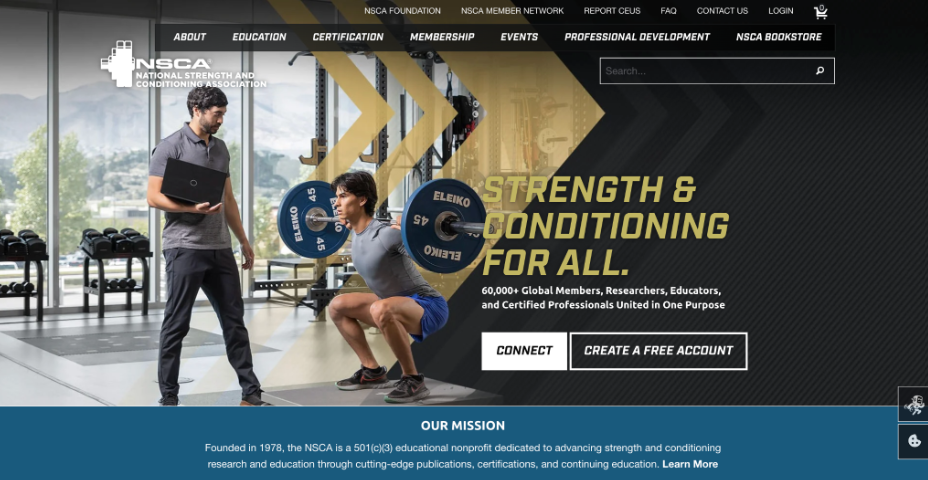
How does NSCA operate?
The NSCA has been a leading authority on strength and conditioning since 1978, making it one of the oldest and most research-grounded organizations in the space. As a 501(c)(3) nonprofit, it serves more than 60,000 members globally — coaches, trainers, educators, and scientists. Its certification lineup includes the CSCS, NSCA-CPT, TSAC-F, CSPS, and CPSS. It also publishes the Journal of Strength and Conditioning Research and runs continuing education through NSCA TV and a coaching podcast. The 25-plus Special Interest Groups make it more of a professional community than a certification vendor.
Why pick NSCA?
Trainers targeting athletic performance, sports coaching, or tactical environments will find that hiring managers in those fields actually look for NSCA credentials. The research-backed curriculum means the knowledge base translates directly into client results — and that matters more over a long career than passing one exam.
The review roundup
The NSCA’s nearly five decades of established credibility tend to speak louder than individual reviews. Professionals in strength and conditioning consistently treat NSCA certification as the field’s benchmark, particularly the CSCS, which carries real weight in athletic and performance settings.
NCCPT — Best for affordable personal trainer certification with personalized support
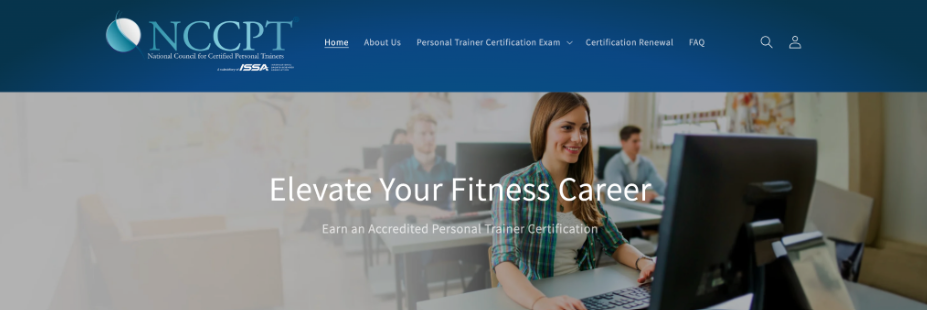
How does NCCPT operate?
NCCPT has certified personal trainers since 1988, with a consistent focus on keeping quality education accessible. Its NCCA-accredited Certified Personal Trainer program is packaged under $720 — a meaningful difference from competitors pushing past $1,000. The learning format leans on micro-video lessons, live study sessions, and direct coaching from practicing trainers rather than automated systems. NCCPT also carries military and GI Bill approval, which reflects a real commitment to reaching a wider audience.
Why pick NCCPT?
Budget-conscious candidates who don’t want to sacrifice prep quality will find NCCPT’s mix of transparent pricing and first-attempt pass rates above 80% compelling. The hands-on trainer support model is a real differentiator in a space where most platforms rely on pre-recorded content and leave candidates to figure out the rest.
The review roundup
NCCPT’s positioning as the more personal, more affordable option lands clearly with its audience. Students frequently highlight direct access to working coaches as the standout feature, which is rare at this price. That kind of personalized attention during prep tends to lift first-attempt pass rates.
Selection framework: how each pick was evaluated
The process behind this list started with sourcing public information, then stress-tested it against real-world signals before any certification made the final cut.
Gathering information. The starting point was a broad list of fitness certifications drawn from several directions at once — directories, review aggregators, official websites, and case studies from industry publications. The goal here wasn’t to rank anything yet, but to make sure no important option was missed.
Filtering the list. Once the full list existed, options without verifiable accreditation or a documented track record were removed. Review patterns across platforms were analyzed for consistent themes, positive and negative. Certifications showing signs of inflated or inconsistent feedback were flagged and deprioritized in favor of more stable, credible records across candidate types.
Cross-checking against source material. Claims made on official websites were checked against what actual candidates reported in verified reviews. When an organization stated a high pass rate or broad employer acceptance, that was weighed against real outcomes. Options where the marketing outpaced the evidence were treated with caution.
Industry standing. Each certification’s standing was assessed through recognition signals — awards, mentions in credible publications, and partnerships with established employers. Organizations appearing repeatedly across reputable outlets carried more weight, and documented relationships with professional sports organizations, major chains, or healthcare systems scored higher.
Real-world evidence. The final check focused on whether each organization delivers on its promise: program pages reviewed for depth and specificity, whether the certifications show up on job postings and employer preferred lists, and confirmation that study systems, CEUs, and career tools were genuinely part of the offering rather than marketing filler. Only certifications that held up across all five stages made the list.
Choosing the right certification: a quick guide
Not every certification fits every career path, so the right pick depends on a few factors worth thinking through before you commit to an exam fee.
- Track record. Look for bodies with a long history in fitness specifically, not general wellness or adjacent health fields. Longevity usually signals the credential has survived employer scrutiny over time.
- Features and services. Check whether study materials, continuing education, and specialization pathways are included or cost extra. A low entry price gets expensive fast if every add-on is billed separately.
- Pricing. Compare the full cost to pass, not just the registration fee. Factor in study packages, retake policies, and CEU requirements across the recertification cycle.
- Results. Pass rates and employer acceptance are the two numbers that matter most. Any certification worth considering should point to both with confidence.
- Compliance. NCCA accreditation is the clearest quality signal here. Verify it directly before committing, since employer preferences often track accreditation rather than brand name alone.
Wrapping up
Picking the right fitness certification comes down to three things: NCCA accreditation, employer acceptance, and whether the prep resources actually set you up to pass. The five options here each serve a different candidate — from budget-focused newcomers to career-driven specialists. As the industry grows and employers raise their credential standards, getting this decision right from the start matters more in 2026 than it ever has.
 Brian Mossoratti has opinions about shopping tips and guides. Informed ones, backed by real experience — but opinions nonetheless, and they doesn't try to disguise them as neutral observation. They thinks a lot of what gets written about Shopping Tips and Guides, Gift Ideas and Suggestions, Seasonal and Holiday Gifts is either too cautious to be useful or too confident to be credible, and they's work tends to sit deliberately in the space between those two failure modes.
Reading Brian's pieces, you get the sense of someone who has thought about this stuff seriously and arrived at actual conclusions — not just collected a range of perspectives and declined to pick one. That can be uncomfortable when they lands on something you disagree with. It's also why the writing is worth engaging with. Brian isn't interested in telling people what they want to hear. They is interested in telling them what they actually thinks, with enough reasoning behind it that you can push back if you want to. That kind of intellectual honesty is rarer than it should be.
What Brian is best at is the moment when a familiar topic reveals something unexpected — when the conventional wisdom turns out to be slightly off, or when a small shift in framing changes everything. They finds those moments consistently, which is why they's work tends to generate real discussion rather than just passive agreement.
Brian Mossoratti has opinions about shopping tips and guides. Informed ones, backed by real experience — but opinions nonetheless, and they doesn't try to disguise them as neutral observation. They thinks a lot of what gets written about Shopping Tips and Guides, Gift Ideas and Suggestions, Seasonal and Holiday Gifts is either too cautious to be useful or too confident to be credible, and they's work tends to sit deliberately in the space between those two failure modes.
Reading Brian's pieces, you get the sense of someone who has thought about this stuff seriously and arrived at actual conclusions — not just collected a range of perspectives and declined to pick one. That can be uncomfortable when they lands on something you disagree with. It's also why the writing is worth engaging with. Brian isn't interested in telling people what they want to hear. They is interested in telling them what they actually thinks, with enough reasoning behind it that you can push back if you want to. That kind of intellectual honesty is rarer than it should be.
What Brian is best at is the moment when a familiar topic reveals something unexpected — when the conventional wisdom turns out to be slightly off, or when a small shift in framing changes everything. They finds those moments consistently, which is why they's work tends to generate real discussion rather than just passive agreement.